

Accemic Technologies is the pioneer in Embedded Systems Dynamic Analysis.
Automated. Non-intrusive. Continuous.

Embedded systems have become an essential contribution to our modern lives. Taking over more and more demanding and critical responsibilities, these systems grow increasingly complex executing sophisticated software on powerful processors. This complexity is accompanied by an ever-increasing effort for software test. The cost of testing and debugging is approximated to be 50% of the total engineering costs. Every second hour of engineering is designated to testing. The estimated annual amount of worldwide engineering cost is up to $ 75 billion. Insufficient testing results in costly unplanned project delays and recall actions.
It is our mission at Accemic Technologies to reduce these costs of yours with the help of our innovative technology. We provide you with the means to improve the quality and reliability of your systems and to accelerate their market launch.
With the ever-increasing complexity of embedded systems, the number of software defects is also growing. Disproportionately. Even if your engineers are geniuses.
Our patented CEDARtools® live observation system helps you to control this effect.
Accemic Technologies has developed and matured CEDARtools® a novel dynamic analysis technology. We make software tests for embedded systems more effective and efficient. We simplify the debugging process and provide you with the leverage you need to pin down the root causes of sporadic, non-deterministic failures.
CEDARtools® leverages the trace capabilities embedded into virtually all modern processors. Their trace units expose the details of the operation of the CPU and its peripherals to the outside. However, they easily produce a few GBit of trace data per second. This quickly renders approaches combining storage and offline analysis as infeasible options. We at Accemic Technologies have developed a solution that analyzes this trace-data stream in real time over an arbitrary time frame.
We provide development and test engineers with the powerful tool that boosts their productivity by enabling them to monitor a system over large time frames and to pin down even sporadic errors quickly.
Faultless systems are an unachievable challenge. Nonetheless, closing in on this ideal should be the ultimate goal of any serious project management. In addition to a well-thought-out system architecture and a thorough implementation,
- tests as complete as possible and
- precautions for dealing with errors in the field are important prerequisites for the ability to develop and market products on time and in the best possible quality.

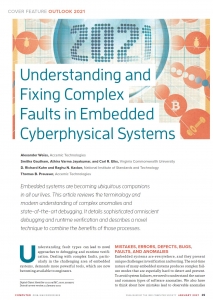
IEEE Computer Magazine Article: Understanding and Fixing Complex Faults in Embedded Cyberphysical Systems
Together with our engineering colleagues from Virginia Commonwealth University and NIST: National Institute of Standards and Technology, we have expanded our white paper into a full article and are excited to have it published in the January 2021 issue of IEEE Computer Magazine.
“Understanding fault types can lead to novel approaches to debugging and runtime verification. Dealing with complex faults, particularly in the challenging area of embedded systems, craves for more powerful tools, which are now becoming available to engineers.”

Whitepaper: Understanding Embedded Trace
Embedded Trace is an integral part of nearly all modern processors. This whitepaper summarizes the essential facts about this powerful but still far too seldom used functional unit that application engineers, test engineers and project managers should know in order to test, optimize and debug a system efficiently.
This paper briefly discusses the problems associated with software-based instrumentation and how non-intrusive electronic probing was defeated by advancing computer architecture and system integration. We then identify embedded trace as the solution to this observability conundrum laying out the techniques that enable efficient and economically reasonable implementations for this innovative technology. We describe the challenges in bandwidth and volume that are faced by hopeful observers and backend applications highlighting the benefits of modern innovative online analysis capabilities. Finally, we provide a short overview over common physical trace interfaces and simple guidelines that ensure that your next system design is capable of leveraging this cutting-edge technology.
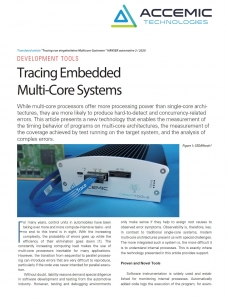
Tracing Embedded Multi-Core Systems
While multi-core processors offer more processing power than single-core architectures, they are more likely to produce hard-to-detect and concurrency-related errors. This article presents a new technology that enables the measurement of the timing behavior of programs on multi-core architectures, the measurement of the coverage achieved by test running on the target system, and the analysis of complex errors.
Original German version of this article @ Hanser Automotive 03/2020